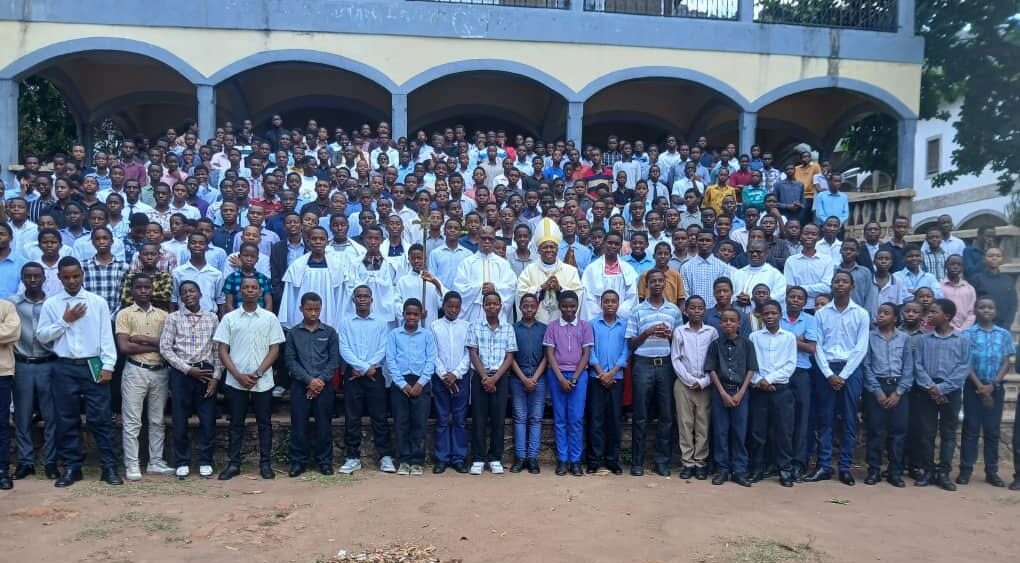
It was no ordinary Sunday, and no ordinary Solemnity of Our Lord Jesus Christ, King of the Universe, for the seminarians of St. Paul the Apostle Seminary (SPAS).
The day was graced by a distinguished son of the house, Rt. Rev. Vincent Mwakhwawa, who returned to his Alma Mater, not as the young seminarian he once was, nor as the young priest he later became, but as a Successor of the Apostles, to preside at the Holy Sacrifice of the Mass.
It was, in every sense, a homecoming, a return to the wellspring where his priestly vocation was first groomed.
In the words of the ancient Roman poet Virgil, “Omnia vincit amor”, love conquers all, and it was evident that the Bishop’s love for his former seminary had drawn him back to inspire the next generation of labourers in the Lord’s vineyard.
In a profoundly moving homily, Bishop Mwakhwawa reflected on the pillars upon which priestly formation stands, urging the seminarians to embrace them with fidelity and zeal. The Bishop exhorted the seminarians to pursue their studies with diligence and seriousness, reminding them that “Priesthood needs educated people.”
Echoing the counsel of St. John Paul II, who taught that “the priest must be a man of culture, formed to dialogue with the world,” the Bishop stressed that intellectual formation is not an ornament of priesthood, but an indispensable instrument for evangelisation in a complex and searching world.
Bishop Mwakhwawa recalled the seminarians to the main purpose of the seminary: to form future priests. He cautioned them against reducing the seminary to a mere centre of academic excellence. As St. Augustine wisely observed, “You have made us for yourself, O Lord, and our heart is restless until it rests in you.” Likewise, the seminarian’s heart must find its rest not in certificates, but in the call to configure himself to Christ, the Eternal High Priest. “You are not here merely for a better education,” he emphasised, “you are here to become priests.”
On discipline, the Bishop was unequivocal: discipline is indispensable for success, both in academics and in the priestly life. He urged the young men to cultivate order, punctuality, and self-mastery as the daily grammar of holiness.
Finally, Bishop Mwakhwawa encouraged the seminarians to develop a genuine spirit of manual labour. “The Church does not need lazy priests,” he declared, invoking the venerable Benedictine maxim, “Laborare est Orare” (To Work is to Pray). In the spirit of St. Benedict, who sanctified work as a path to God, the Bishop reminded them that sweeping a floor, tilling a garden, or cleaning a classroom, when done with love, becomes a liturgy of the hands.
In his vote of thanks, the Rector of the Seminary, Fr. Bazilio Msuli, expressed profound gratitude to Bishop Mwakhwawa for his pastoral visit.
He noted that the Bishop’s presence, as a proud alumnus of SPAS, stands as a living example and a source of inspiration to the seminarians, proof that the seed sown in this seminary can, by the grace of God, blossom into episcopal service to the Church.
As the Solemnity of Christ the King proclaims the universal reign of Christ, the visit of Bishop Mwakhwawa served as a powerful reminder that Christ the King still calls, still forms, and still sends forth shepherds after His own Heart.
Communications Office
Diocese of Mangochi